
Back in 2020, I picked up Tim Ferriss' book the 4-Hour Body and discovered a concept that's been floating around inside my head ever since:
The Minimum Effective Dose (MED).
Ferriss championed this in the book (effectively, I think) but its roots go back to 20th century pharmacology and in the fitness world, Arthur Jones, the inventor of the Nautilus brand.
Ferriss used boiling water as an example: 100°C at standard air pressure.
Higher temperatures won't make our water 'more boiled'—they just waste resources.
This fascinated me.
Both for the application in the book—lifting and nutrition, but also because I started thinking about how this mapped onto practicing and playing guitar and ukulele.
And especially jiu-jitsu.
I think this hooked me because until I considered the minimum, I had always been figuring out a way to optimize for the maximum.
The Maximum Is Obvious
Attend as many classes as possible.
Go to all the open mats.
I think we've all done our own version of this before.
In 2013 I went for the maximum—four evening classes, five afternoon classes, an open mat and also two judo classes midweek. I was expecting complete burnout or injury but neither happened and it was actually a lot of fun.
Where things began to stretch thin was at the dayjob.
I have a lot of flexibility in my work. It's both the nature of the work and my tenure and experience.
I did not have a good boss at the time—amongst a long list of other issues, completely inattentive, and after a few months of eleven classes a week they called me into the office for a meeting to ask me what the hell was happening with my job performance.
It wasn't working.
Jiu-jitsu was definitely working, insofar that I was having fun, but my hobby was putting pressure on one of the most important parts of my life outside of it—my career.
The customers were happy, but my production numbers showed a downturn that slowed but didn't level off. It was showing up in my paycheque and even the most incompetent administrator I've ever worked under saw it.
The customers were eventually going to see it.
So I cut the afternoon classes, but was still trying to do the maximum and the injuries started happening.
Cauliflower ear. A dislocated pinky finger. A popping noise in my knee and hip. A pectoral tear.
The time off got longer with each injury—days, then a couple of weeks, then a month, then several months.
Recovering from the pectoral tear overlapped with our annual trip to Seoul. I couldn't play jiu-jitsu with my friends. Worse, I'd convinced a couple of my Canadian friends to make the trip with us, so I had to go to the gym and watch everyone else have fun.
We're out drinking afterwards and 관장님 told me outright to quit judo.
Not because it's intrinsically dangerous.
The problem was me, he advised.
I didn't have the battery for everything I was trying to do.
What's the Point?
Just what the hell was I trying to do?
I told myself I was doing more jiu-jitsu because I loved it.
But looking back, I think I was trying to shortcut skill acquisition through volume. More classes = better, faster.
...
Right?
And I think jiu-jitsu became avoidance. The dayjob was stressful. The gym is fun. So I kept forcing it.
But here's the thing: I was trying to skip the struggle.
My version of this was volume.
Volume felt like work. It felt like I was doing something. But I wasn't doing the hard part—the deliberate practice, the focus, the actual learning where I'd be uncomfortable and not knowing what I was doing yet.
I wanted the expertise without earning it.
Everyone saw me having a great time. My coaches saw me training hard. Jessica heard about all of the friends I was hanging out with.
But my jiu-jitsu wasn't actually improving proportional to the time invested.
I was telling myself I was taking the hobby seriously.
But there was no balance. No strategy. Just volume.
And volume in of itself doesn't work for hobbies. Or skill acquisition. Or anything, really.
It's the journey. It's always the jouney.
Maximum volume was trying to skip that.
When I stumbled onto MED it was the effective part that stuck the pin in my memory.
What happened if I started exploring the minimum?
The Research
A couple of weeks back I came across that 4-Hour Body entry in my journal and it went from floating around to suddenly feeling motivation creeping in.
So I started digging.
It turns out I'd completely misunderstood what "practice" means.
The training session isn't the 'dose'.
The dose is Practice + Recovery.
Dosing Jiu-Jitsu
Vitamin D
Recovery seems obvious—we all need rest.
But I didn't understand how it related to practice until I found research showing that skill acquisition happens in two phases.
The first phase is fast learning—what happens in class when you drill something and it starts feeling less awkward by the end of the session.
It's a temporary sensation. The thing we feel and think means we're getting better.
The second phase is slow learning—the permanent hard-wiring that happens hours after training.
Specifically, 6 to 8 hours after.
We don't just learn the overhead sweep from collar-and-sleeve in class—the process begins there, but the actual performance gains happen between training sessions.
Especially after sleep.
This is why the maximum—and by that I mean volume—failed me.
Here's the mechanism: Learning requires specific proteins to strengthen connections between neurons. Their supply is limited and typically depletes after 60 to 90 minutes of intense focus. The synapses themselves also become 'saturated'—like a sponge that can't hold any more water. At this point, the brain stops encoding. Everything after is junk volume.
And there's a second problem. When I stacked judo on top of jiu-jitsu on top of open mats, I triggered what's called Retrograde Interference. The brain needs a buffer (roughly 4-6 hours) to stabilize the first skill before it can handle a second without overwriting the progress.
I wasn't giving it that buffer. I was training, eating, training again.
The intense focus of the fast phase sends the signal. But once that signal is sent, more reps while exhausted aren't strengthening it. They're just causing wear and tear.
The 6 to 8 hours after class? That's where the difference gets made.
When I'm supposed to be sleeping.
But this opened another can of worms—I train in the morning nowadays.
And I can't just go to sleep afterwards.
But my jiu-jitsu is improving.
What's going on?
It's the Pauses
Bailey encoding all the naughty behaviours of the previous couple of hours
In every jiu-jitsu class I've ever been to we drill in pairs. One rep on each side. Then we switch.
Nobody drills for 20 minutes straight.
We do a bunch of reps back and forth, then we sit around. Maybe chat or watch other people. Then back to drilling.
I always thought this was just how classes work. That it was to just keep people from getting bored. (I've never asked where this came from.)
Turns out that this is compatible with learning:
Research from 2021 found that the brain doesn't learn while we're moving.
We learn when we stop.
Specifically, during roughly 10-second pauses.
And here's the part that stunned me:
When we stop drilling for those ten seconds, our brain replays the movement we just did at 20x speed.
In that 10-second break, our brain might replay that overhead sweep from collar-and-sleeve 200 times. Perfectly.
Without that break, we lose those 200 reps.
Even better:
"In contrast to offline, overnight consolidation, which necessitates sleep, wakeful memory consolidation occurring during ten-second breaks is approximately four times more efficient."
We learn four times faster standing still between reps than we do during the slow-learning phase that happens while we sleep.
"wakeful rest plays just as important a role as practice in learning a new skill."
Every gym I've ever trained at has been doing the Minimum Effective Dose all along.
We just didn't know why it worked.
The Shift
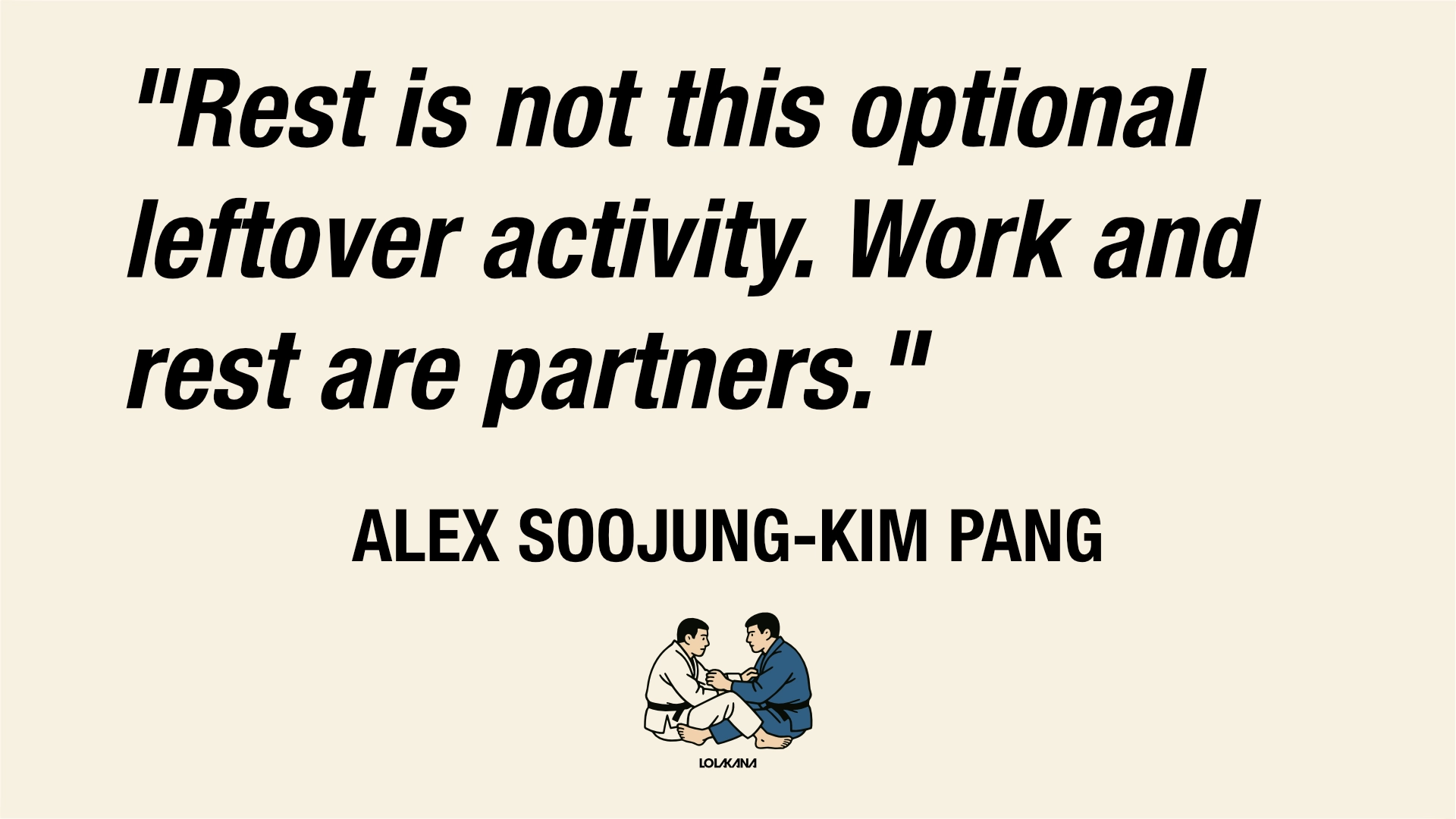
The Minimum Effective Dose for the jiu-jitsu hobbyist isn't a specific number of classes per week.
It's understanding that the dose includes the recovery.
Show up to class consistently.
Take the breaks between reps (your brain is working at 20x speed during those pauses).
Sleep well.
And if you train in the morning like I do now? Nap.
I might be a purple belt in jiu-jitsu but I'm a red belt when it comes to napping. Eleven minutes in the truck, seat back, timer set. I wake up alert. Sometimes with time dilation. Sometimes with dreams.
Research shows even a short nap produces similar consolidation benefits to a full night's sleep for motor skills.
The hobbyist advantage: We have to balance jiu-jitsu with the rest of our lives.
Work. Sleep. Relationships.
That constraint forces the MED.
And it turns out that's not a limitation.
It's the actual mechanism of learning.
Your Turn
This is all new to me.
Who are the jiu-jitsu nerds who came across this and have been working on it?
Are there any scientists in this field that are also jiu-jitsu players?
I'd love to hear from you.
What's your Minimum Effective Dose looking like right now?
Research Cited:
- Buch et al. (2021)—The Gap Effect (Your brain replays the move 20x faster when you take 10-second breaks during practice).
- **Karni et al. (1998)—Fast vs. Slow Learning (Your brain cements the skill 6+ hours after practice, primarily during sleep).
- Smolen et al. (2016)—Synaptic Spacing (Chemical pathways for memory have a refractory period; spacing your practice out is biologically required to replenish them).
In Victoria, British Columbia?
Lolakana Martial Arts has 20+ classes a week for both adults and kids in Brazilian Jiu-Jitsu, No-Gi Jiu-Jitsu and Kickboxing.
Free parking.
Indigenous-owned.
Click here for our Free Unlimited Trial Week


