
Let's play jiu-jitsu.
We love to practice the sport, but when we go around telling outsiders we're practitioners—it makes jiu-jitsu sound like some sort of quackery alternative medicine.
And saying we 'train jiu-jitsu' sounds like we're begging to be asked 'what for?'
And we have to stop telling people we 'do' jiu-jitsu—it's not a code word for hard drugs.
The Blank Stare
I was a do-er:
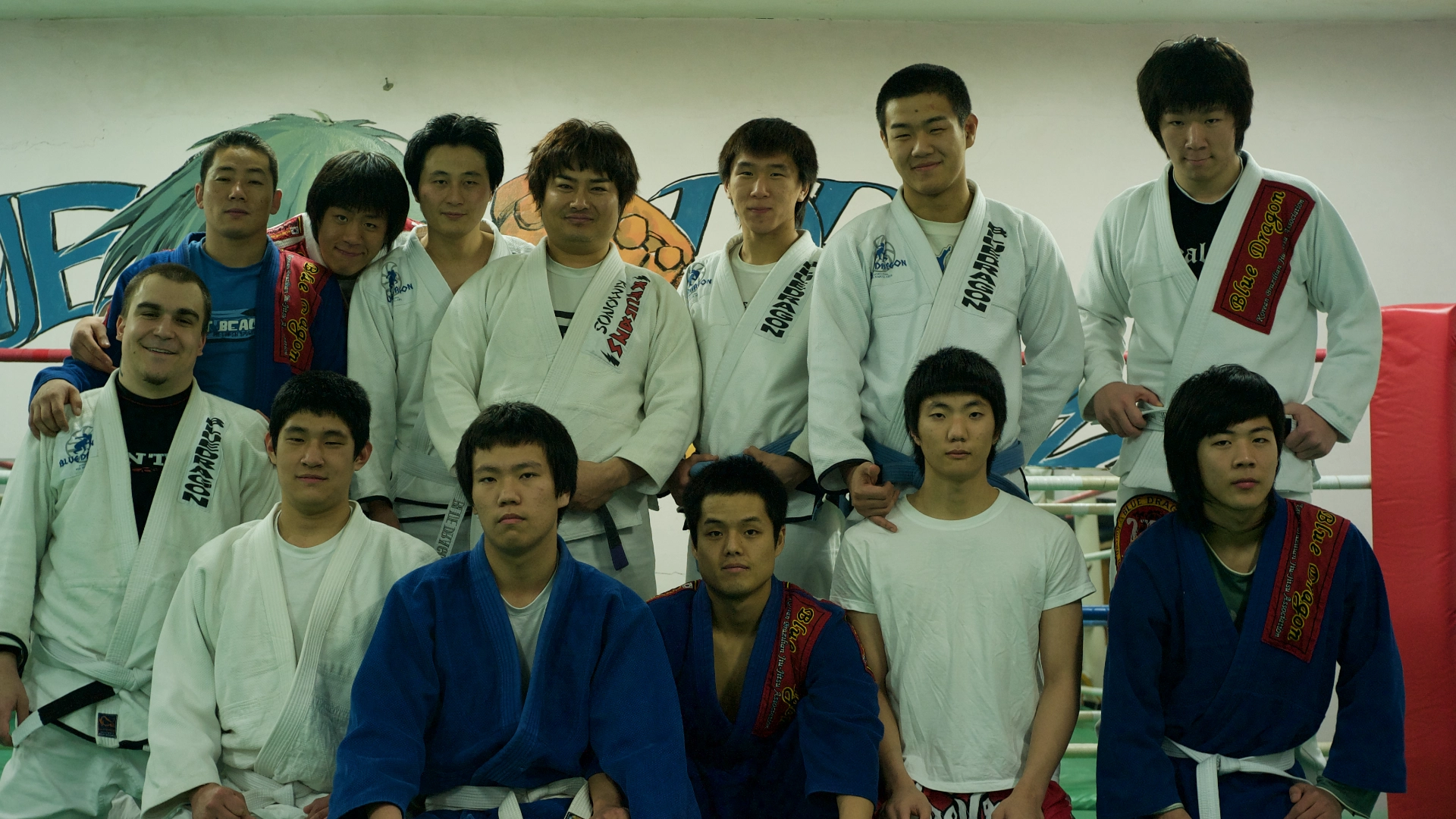
Doing jiu-jitsu at 부천 Blue Dragon
Back in the early 2000s, when someone asked about my weekend and I mentioned jiu-jitsu, I'd get blank stares. This was before MMA went mainstream—outsiders who knew anything called it "ultimate fighting." I'd explain (poorly) that jiu-jitsu was like wrestling but you could attack necks and joints to make opponents give up.
That didn't help.
I'm a salesperson. I started treating this like a marketing problem—watching how other people who had been around longer than me talked about the sport.
Glazed eyes. Polite-but-curt nods. Eye rolls and snickering once people walked away. Symptoms of confusion, boredom, contempt.
We were really getting this wrong.
Even after The Ultimate Fighter launched in 2005 and MMA went mainstream, we were still confusing people with our phrasing. Worse—we came across as cheesy, trying too hard to sound legitimate.
I couldn't let it go.
Most of us are hobbyists who want to share something we love without sounding like we're training for an MMA fight.
The words we use shape how we think. Without language for fundamentals—guard, passing, sweeps, submissions—we couldn't even practice the sport. Someone had to name those things first.
But we were still stuck stepping onto a linguistic obstacle course just trying to share our enthusiasm.
The answer was right there in how the Japanese talked about it.
The Problem With 柔術
It's a noun.
That's really the problem.
Sports that are verbs become agent nouns in English with an -er suffix—a wrestler, a racer, a runner. There are a few nouns that do this too, like cricketer and footballer, but no one goes around calling themselves a jiu-jitsu-er.
It's a romanized loan word from Japanese, and they actually have their own version of the same problem. Casual conversation gets phrasing like shugyosha (修行者, trainee) or BJJの人, (literally BJJ-person.)
Maybe you're like me and watch Olympic judo and the IJF highlights and think you know a solution—the -ka (家) suffix, literally 'person of'. And Neil Adams, the Voice of Judo describes athletes and competitors as judoka all the time.
But English speakers took that without asking. And we didn't bother with the notes. Its usage is nuanced—expertise, a life built around an art. Career professional, not a hobbyist. Japanese MMA promotions started using it occasionally when describing skillsets, but most of the time it's reserved for headlines and documentation more than speech.
But we don't want to be jiu-jitsu-ka (柔術家) anyways.
Trust me. It'll get romanized and mispronounced (especially the third syllable) and the English-speaking world will become the laughing stock of the jiu-jitsu community.
The Solution
The Japanese have the answer—and the English translation gives us ours:
When broadcasters need a neutral term that works for hobbyists and professionals? They use senshu (選手)—a competitor, an athlete, or...
A player.
Senshu and player aren't just neutral—they're useful. There's no judgement about mastery, and no pretense about "artistry" (yes, I'm making air quotes). And they answer the two questions every outsider asks:
- What do you do? → I play jiu-jitsu
- What are you? → I'm a jiu-jitsu player
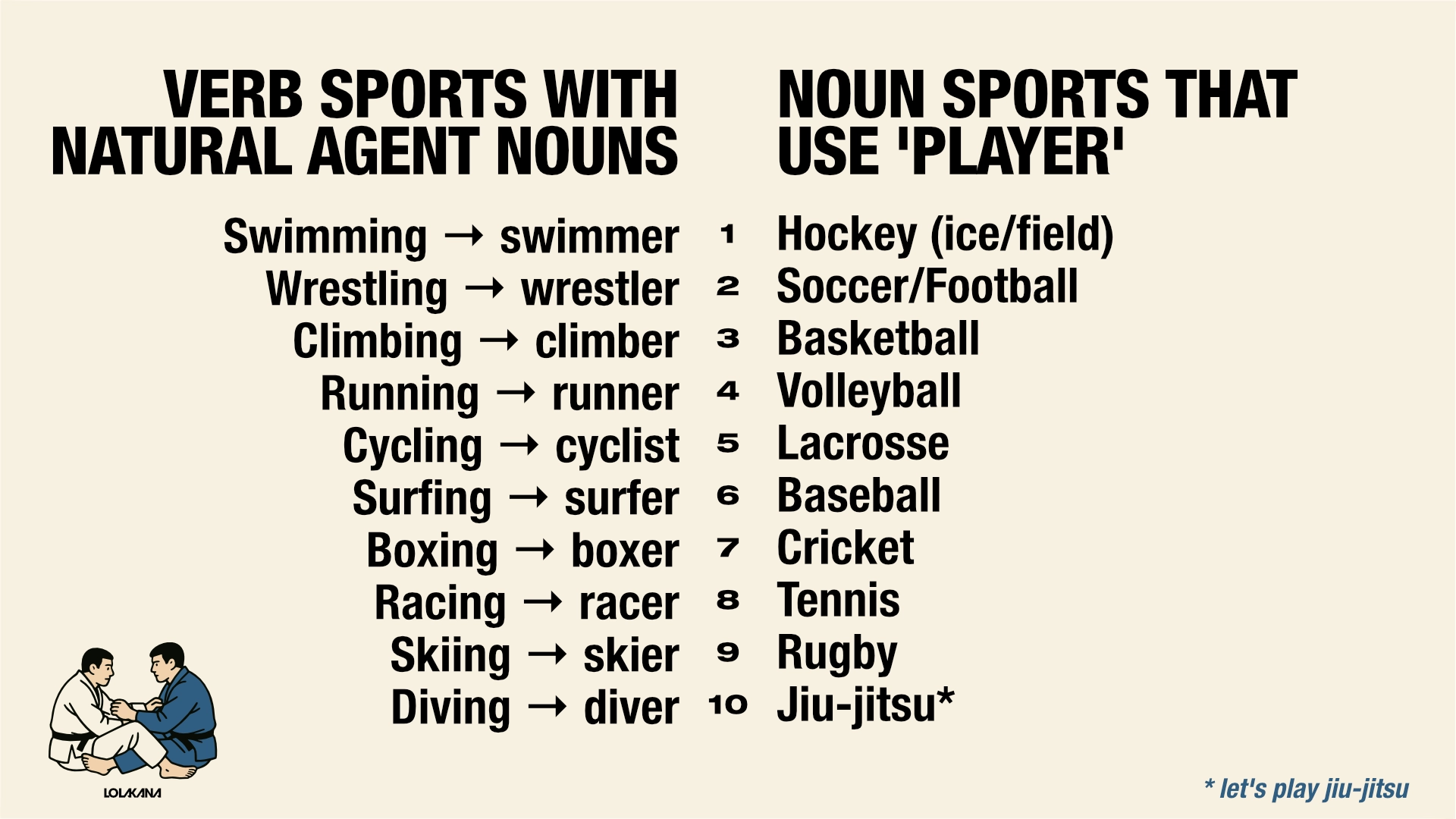
The Payoff
Go ahead and tell someone you're a jiu-jitsu player. Watch what happens.
"You say play!", blurted out a colleague at a meeting most recently.
"You play jiu-jitsu?", asked a new boss a couple of years ago.
Both wanted the same clarification: why play?
Curiosity. Not confusion, not boredom, not contempt—curiosity.
But the real proof came years earlier, starting with my wife Jessica noticing this sticker I was working on back in 2017:
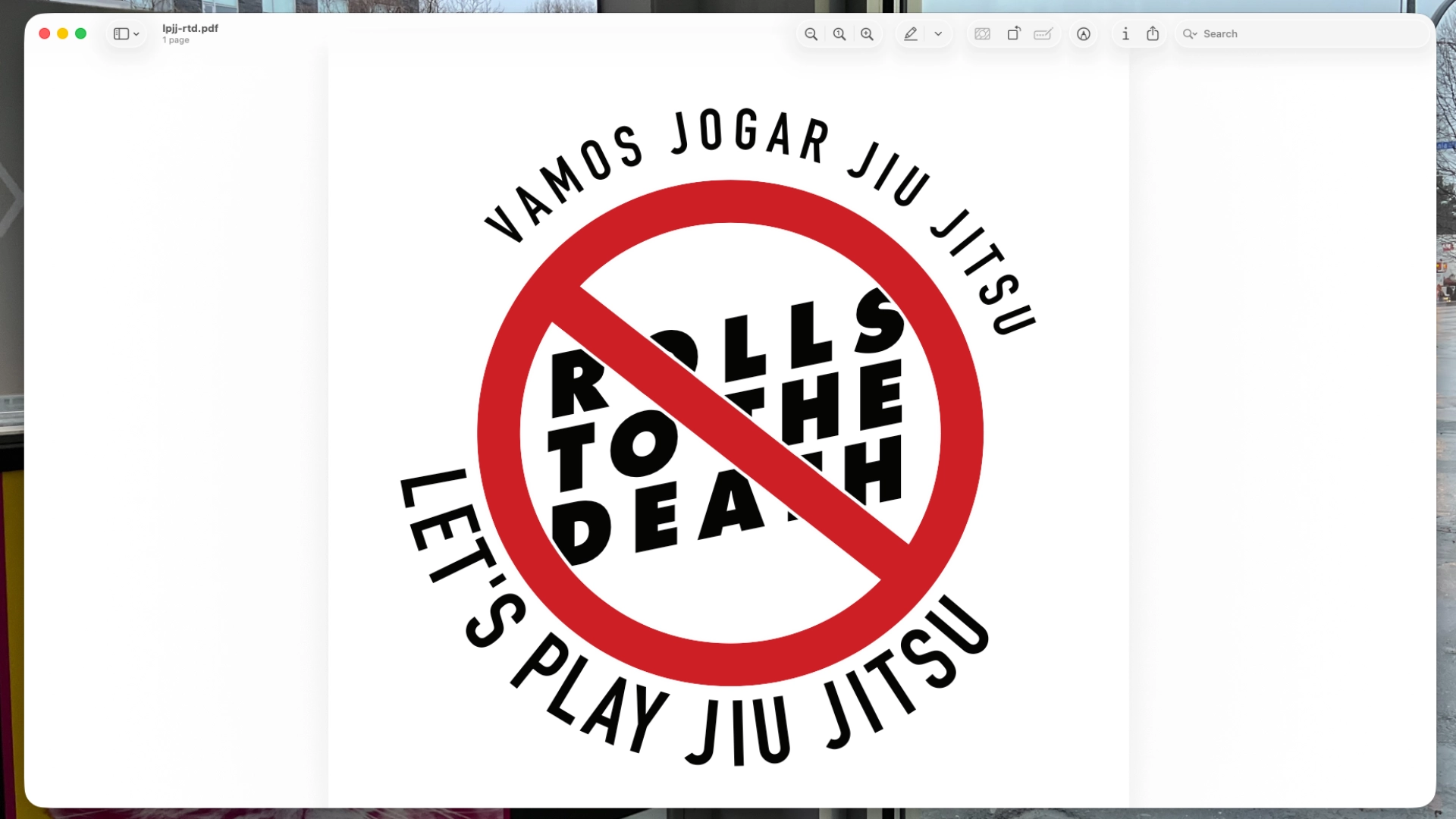
This was after years of me and our friends talking about jiu-jitsu at brunch—getting punched in the face by spazzy white belts, catching random elbows and knees to the groin, smashing and crushing and destroying souls. All hyperbolic war language that makes outsiders think we're psychotic.
It killed a lot of the interest. But 'play' kept a door open—even through years of the same brunch war stories.
Then 2020 happened.
COVID shut down her spin and dance classes. She went stir crazy. When the gym opened first, we finally got her on the mats.
She didn't spaz. Didn't poke me in the eyes. Didn't injure herself.
She's a retired competitive rhythmic gymnast and dancer—she takes instruction well. Asks questions. Sees the connections between positions, techniques and movement.
She glimpsed the intellectual part of the sport immediately.
She experienced what being a jiu-jitsu player means. Not the war stories.
Now she's a casual player who shows up when she feels like it and has fun on the mats.
And she's brought others: a coworker first, then her sister.
Play opens doors. Then it opens more doors.
Verbal Jiu-Jitsu
So try it.
It sounds weird at first. But then it doesn't.
It's like verbal jiu-jitsu—a technique you practice until it becomes automatic. It doesn't need to be drilled hundreds of times like a butterfly sweep, but you do need to remember to use it the first few times someone asks.
Say it aloud:
I'm a jiu-jitsu player.
I play jiu-jitsu.
Watch what happens.
Next week: Motivation Fades. Systems Don't.
In Victoria, British Columbia?
Lolakana Martial Arts has 20+ classes a week for both adults and kids in Brazilian Jiu-Jitsu, No-Gi Jiu-Jitsu and Kickboxing.
Free parking.
Indigenous-owned.
Come check us out.


